11/20/2007

Thailand- 1

Ante script- It is difficult for me to write individual emails, but I do apreciate hearing from you. I've been away for about 3 months now, it'd be nice to hear from you.

------------------------------------------------------------------

Spent a few days in Bangkok (12 million), about half the people as Shanghai but about twice as dirty--congested streets/sidewalks, lots of noise and exhaust fumes. The back allies are really cool. It is a very dense place, where you can get lost amidst endless sideroads with interesting
things going on, like the local garbage man:
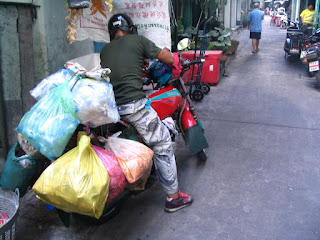
From what I have seen, Bangkok is mostly very unappleaing highways/malls/prostitutes/designer crap/blah.
One bright note was this Chitachuk market. A vast (5 square km or so) market crammed to the brim with stalls selling all sorts of stuff: cloths, art, books, food, and animals (so bad).

(here a guy mixing carnation instant breakfast ( ha!), the hard way)
So many people, you wouldn't believe people could stil move--it was not a place for the claustraphobic.
(hard to capture, but it was this crowded everywhere)

The density of the crowds also made the heat swealtering. I spent about 4.5 hours there and could have spent more had I not made a fruitless attempt at trying to get to the zoo (which was much more than a walk away! I discovered).

While in China I found a roundtrip flight from Bangkok south to Surat Thani for $0 + tax =$30. On the flight, I met an Austrian girl and a German couple who thought I had a good plan to get to one of the Islands (Ko Pha Ngan in the Gulf of Thailand) from the plane. So they came with me and we rushed from a taxi to catch the last boat of the day. On the boat a I guy sold us on a cheap bungalow (that turned out legitamite, fourtunatly) and we took his car to the place.
In all I had to take a bus-shuttle bus-plane-taxi-boat-taxi; although only 10 hours travel. Amazing how much travel you end up doing, eh!

The island is much more of what you would expect of a place like Thailand, it's pretty nice.
Liza, the Austrian chick I met on the plane, and I rented a scooter and buzzed about the island.
Went for a hike in the jungle. Had to Indiana Jones it a bit,

but we found the waterfall we were looking for.

The ants here are nasty--they're everywhere and they bite.

Another trip we made in search of yet another waterfall wasn't so lucky. We had to ditch our bike early, as the roads here can be pretty dodgy.

But we did come across some elephants.

And, on many of the trees along the road, there were all these sliced coconuts hangnig on the side, collecting this white goo. It felt like rubber and smelled like s*#t; don't know what it was.

The night market, in the only town on the island Song Thala, has been a cool place to eat dinner. It's outside and every vendor brings different options. Getting some good ideas to cook, e.g. rice steamed with coconut. And I can't seem to resist getting the $1 fruit shakes with basically every meal--coconut, banana, mango....em...

As we were on our way to check out the northern part of the island, Liza abrutly checked out on me for another island. I'm sure she was a bit over our partnership, as was I, but boy did she miss out...


The place I've found (and remained for a week) was fantastic; in fact, I've decided to stay here for a while: it's just the sorta place I've been hoping to find. I've got a little bungalow on the side of a beautiful, somewhat remote beach.
The view from my hammock:

It's only a bed and a hammock, but for $5/night I'm happy to walk a few minutes to the nearest running water (sink, toilet, shower) and live w/out electricity.
If you are looking for a great place to escape to the beach for some peaceful vacation, I highly recommend the Coral Bay Resort on the north side (Hat Khom) of Ko Pha Ngan. Tops!


Full moon party was pretty cool too... Save the fact that you had to think twice every time a local looked friendly towards you. For, more often than not, they were just trying to sell you glowsticks, alcohol, drugs, or sex.


11/11/2007

China 6- last bits and pieces

On my second to last night in Hangzhou a crew from CCTV (Chinese Central TV) showed up in our hostel. They asked a friend of mine, Yuping, and I to do a small spot for them the next day as part of a cultural heritage thing they are doing for Beijing 2008. I had to skip a shift of mine at the hospital, but they took us out to this swanky place in the mountains and shot 3 small scenes of me, the foreigner, and my friend Yuping, the translator, discovering the wonders of Chinese culture--it was pretty cheesy/phony. But it was really fun. Yuping and I had to make up our own lines--I don't know if they'll actually use the audio. And they paid me 200RMB/$25. They said it is going to be broadcast internationally before the next Olympics, so we'll see!


That night, Yuping threw me a little going away party. Hanging out with some friends and the staff I'd lived with for the past couple weeks was great. But I got so sloshed my morning departure to Ningbo was none too fun.


Taking a train ride here you can not only take in a lot scenery, but you can get a pretty good glimpse at where people live and work. Train rides also afford you a sufficient sample of the land to see that buildings--apartment projects, bridges, roads, etc.--are rising from the ground like mushrooms in fall: ubiquitously and quickly. Furthermore, it seems to me that China's infrastructure is superior to that of America. From the modern roads and highways (that all have seperate lanes for bikes/slower vehicles and street signals more advanced than ours), waterways, bridges, overpasses/underpasses, to the extensive rail system, China has invested heavily in its public transportation system--at what cost to individual wealth I do not know...
(hard to capture on camera)


Spent a few nights in a city to the east of Hangzhou, called Ningbo. I quite liked it. I found a $3/night hostel and made friends with a girl who worked there. She helped me find some of the more intertesting places and plenty of back roads to keep me happy. I much prefer the backstreets to the main streets--which are the same in most cities across the world, methinks.


I'm gonna miss how they speak and use the words 'jigga' and 'nigga'-- this/this one and that/that one. They use the word nigga like we use 'um' or 'like', saying it all the time and it cracks me up: ''nigga niggaaa, nigga niggaaa....;" their verbal buffer.


Finally figured out a reliable way to get what i wanted at restaurants: I would just go to a market and buy the vegetables I wanted, bring them to a small restaurant place and say 'stir fry noodles/rice with this' (chao mien tiao er jigga). I realized this only after a friend of mine bought me a few heads of broccoli after i told her i liked it but could not find much of it in restaurants; and of course i wasn't going to cook it myself when i could get someone else to for a 75 cent meal.

I made a day trip to an island near Ningbo, called Putuo Shan, that had been recommended to me by a couple sources . What was apparently an island of religious recluse, has become a tourist site/trap more geared to commerce than communion. For 8 hours travel (taxi, bus, boat and reverse) and 300RMB/$40, I'm not sure it was worth it.


Got one more ($3) massage--that I just have to mention. It was more like acrobatics than a massage, really. This little girl, maybe 5'4 130lbs, had me in the wildest positions: contorted around her, above her, hanging off her over the side of the table. It didn't exactly feel all that relaxing by massage standards, but, then again, I was moaning and laughing half the time.

Lastly, I spent a couple nights in Shanghai. Fortunately I had a contact with whom I could crash, for Shanghai is a long ways away from the cheap China we reflexivly think of. With over 20 million people, and the traffic/buildings/noise to prove it, I, again, reaffirmed my distate for large cities.

Nevertheless, only just getting out and about, I have not been able to escape the friendliness and generosity that the Chinese people have extended me. From sharing conversation and food in small restaurants to people chatting me up and taking me with them for tea, the Chinese people have impressed me.
I've had a great time in China and could easily come back some day.

11/05/2007

China 5--in the Hospital

Most of my time here in Hangzhou has been spent in the Zhejiang Provincial Hospital of Traditional Chinese Medicine (TCM), so I thought it worth a post of its own.
I do two 4 hour sessions a day. Mostly in the acupuncture outpatient department and specialty herbal departments, but also the Tuina (Chinese massage) department and in the inpatient wards (doing rounds in different parts of the hospital).

Acupuncture
In the acupuncture clinic there are 19 cubicle beds and 10 chairs. They are often mostly, if not completely, full for the better part of each 4 hour shift. 3-4 acupuncturists work at a time with student assistants. There are very few records kept (as far as I can tell), pretty much just the patient cards in which dates of treatment are recorded.

Tools:
-they use only free hand, disposable needles. Needles are sometimes disposed of in plastic disposal containers; just as often in trash cans or trash bags; and there a many needles scattered about the floor.

They use moxa rolls extensivly. the place is well ventilated when it's warm, far less so when it's cold and the windows have to be closed; in which case it is quite smoky. (I have heard that some of the former doctors here have died of lung disease--a testament to how toxic moxa smoke is.) For the moxa rolls they have this cool 8 pronged pitch fork to light and hold the rolls.

-they also have this nifty device to press out moxa cones that they then put on an herbal cake (of Bi syndrome herbs) to put on the skin.

-all of the Electro Acupuncture machines are without clips; just loose wire endings.

-they use a 'thick needle' of 80-120mm that they use to thread down the spine, often for neurological and dermatological conditions. I had it done on me just to see what it was like. I am usually not sensitive to needles, but I became faint and a little nauseous with this one.


Injections:
they do a lot of injections here.
-B12: often at ST36 to build immunity or sometimes SJ17 (in the hole behind your ear--ouch!) for paralysis, tinnitus, deafness. I even saw them do it on ST3 (on the face) for paralysis.
-Dan Shen/Salvia: locally for pain
-one's own blood: drawn from the cubital crease and injected at e.g. ST36, also for immunity and allergic diseases. I'm told it's an antiquated technique from Western Medicine.
-and others.

Techniques:
-Needle insertion: they insert very quickly free-hand, often many points in quick succession--abdomen and face especially, but you see very few winces here.
-Needling: They are also more aggressive than we tend to be--to confirm what we had always heard. I've seen them needle very deeply, lifting/thrusting GV15 (back of neck), CV23 (front of throat), and BL40 (behind the knee). Saw jinjin and yuye (under the tongue) pricked on a guy with aphasia, every GV (spinal) point needled with EA on almost every point, a 2 year needled as his father restrained him while he was crying in an opisthotonic spasm, and a lumbar puncture (by a Western doctor) that would dispel any acupuncture student's fear of needling a point on the GV meridian.
-Abdominal/turtle Acupuncture: they do a lot of abdominal acupuncture. somewhat new a style, it is a microsystem on the abdomen in the shape of a turtle. Many of them swear by it and patients often say they get better immediatly.
-Moxa- not as much direct moxa as i expected, although I've seen it done for plantar warts a few times--in which the patient comes in a just does it themselves. But they do a hell of a lot of the rolled moxa--great, but very smokey.

-Gua Sha- I have not seen it done once.
-Cupping- done a lot. Washing them is done like an afterthought--not much.
-Blood letting- haven't seen it done.
-Catgut implantations- where they insert an acupuncture needle through a hypodermic needle to implant a small piece of catgut (what is used for internal sutures) under the skin in order to stimulate a point for 4-6 days (they say). Only saw it done on the abdomen for weight loss, but could be used for anything really.

Prices: $1=7.5RMB
-needles- 20RMB
-cupping- 3RMB
-EA- 3RMB/pair
-moxa: 5RMB....etc
-total would come to about US$5
----strange scheme if you ask me. But it is pretty damn cheap. The government pays for much of the hospital expenses; for, with prices like that, more money has got to come from somewhere.

Dr. Xuan, the head of the acupuncture department, sees the most people. I have followed her as she saw about 25 people in less than 40 minutes for the first round, 15 on the second, maybe 10 scattered patients after that in a 4 hour shift. She just walks around the room, somehow knowing who is where, walks up to a patient, somehow remembers what's going on with them--for she sometimes barely says a word to them, and starts inserting needles--quickly. That she often does this very popular abdominal acupuncture helps her move so quickly. She often sees people 3times/week, so there need not be much discussion beyond the repetition of the treatment.

Dr. Xuan is what they call a national level doctor. The top level (above the provincial doctor and what more i don't know), she is paid more than other doctors but I'm not quite sure how they attain such status. She taught us a class on abdominal acupuncture, I think I might use some of it myself, in combination with what I already knew.

The acupuncture clinic is mayhem by US standards. There are up to 40-50 people in there at one time. Most people are getting treated, then there are those accompanying, the doctors and the students/assistants. A big open room with many dividers (just low enough for me to peak over) and chairs, it is like a community acupuncture sorta setting.

People come, hang about, get treated, talk with those around them, read the paper...Acupuncture, It's no big deal here.


(hard to see, but she's fanning the moxa smoke)

Herbal Medicine

The specialty clinics (internal medicine, endocrinology, rheumatology, etc) in which doctors use mostly herbal medicine (it's a TCM hospital), but also some Western medicine, are fantastic places to gain clinical experience as a student. The conditions here in which students observe doctors is extremely educational. There are many many patients presenting different variations of conditions, the doctors often stop to explain or point out something or give their diagnosis, and the students get to see what the doctor prescribes/recommends. Far better than what we have, it does not compare. Of course we have no such hospital nor do we study Western medicine as extensivly as they do; much of their time is spent figuring out the Western diagnosis--looking at lab results, medical imaging, or doing a pelvic exam, for example.

The students here seem to be very well educated--in both Chinese and Western medicine. The english vocabulary, for instance, coming out of their mouths often startled me--thymectomy, gastroptosis, lassitude....it's just their grammer and pronunciation that can sometimes leave you stumped.

I spent a lot of time with Dr. Lu, another national level doctor, seeing patients with rheumatic conditions, which he would diagnose within seconds. I learned a lot shadowing him.


In general, the doctors here, like a teacher of mine in Boston, BJ Wang, prescribe at least 12 to 15 herbs at a time, more often 15 to 20+. The vast majority is raw herbs, some patents, very little powder, and also Western Medicine. The two forms of medicine are idealy integrated in these clinics. The doctors order and assess lab work and medical images, ask questions of both forms of medicine and prescribe either as they see fit.
By the way, it was amazing how often patients would leave the doctors office with a referrel for some blood work, CT, X-ray, whatever and return within the hour for the doctor to look at it and then prescribe something. I have not done it myself, but I think such things would take days, if not weeks, to do in the US. And there are no appointments here: they just show up and get in line. How it so cheap, though, I can't figure out. An ultrasound, for example, was about US$10, a Dr. told us.


And the bike parking lot in the basement was quite a sight. I thought there were a lot of bikes in Holland!